Student Recycling Competitions: A Complete Guide to Boosting Engagement
Student recycling competitions can increase participation by 200-300%. This complete guide covers competition types, design, tracking, prizes, and pitfalls to avoid.
By Genesis 1 Technologies · Published 2026-05-26T15:45:53.000-04:00
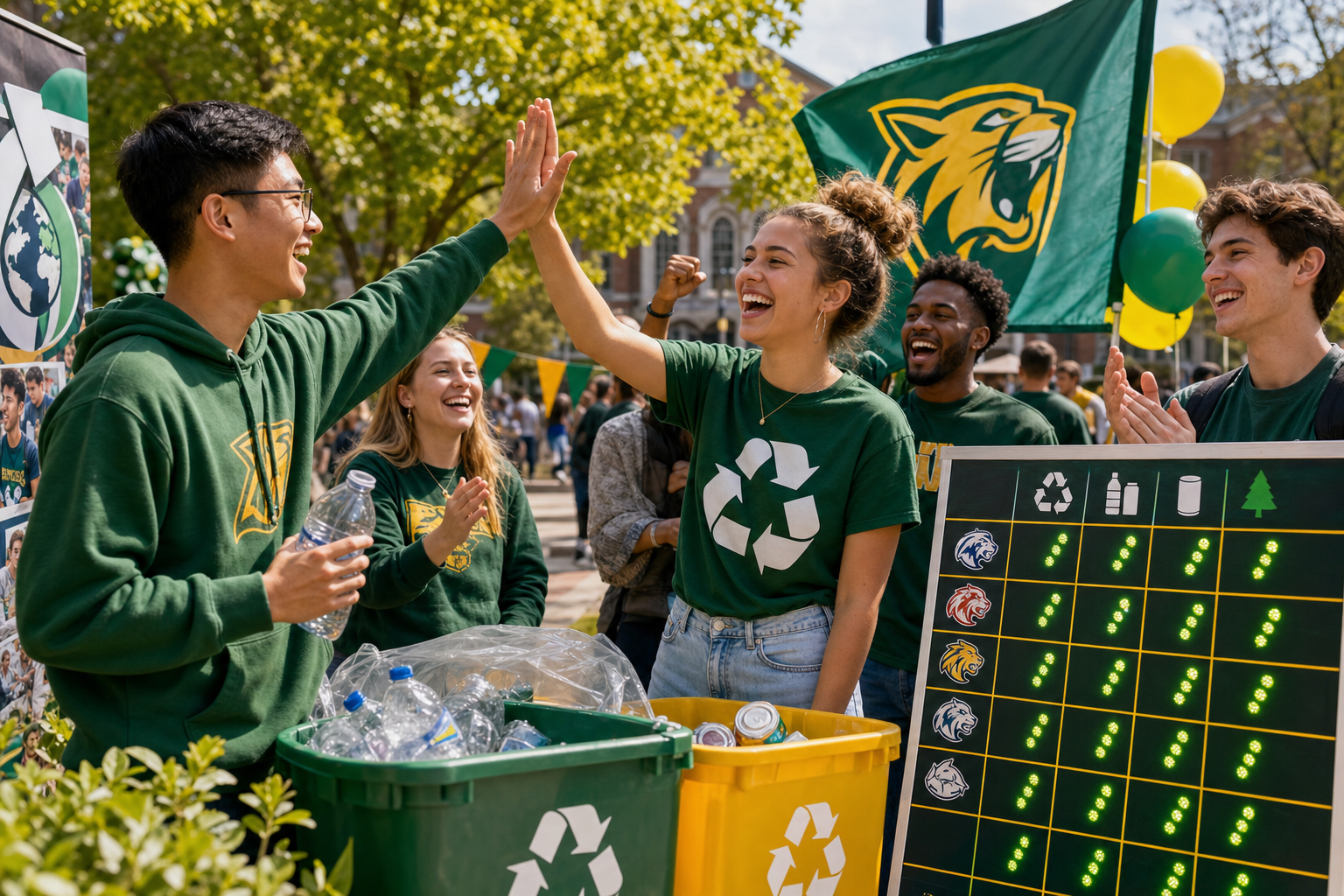
Nothing motivates college students quite like competition. Rivalries between dorms, Greek organizations, and academic departments run deep. When channeled constructively, that competitive energy can transform campus sustainability programs.
Student recycling competitions leverage this competitive instinct to drive engagement, improve recycling accuracy, and build lasting habits. This guide covers everything you need to know to launch and run successful recycling competitions on your campus.
Why Competitions Work
Traditional recycling programs rely on individual responsibility: "Do the right thing because it's good for the environment." While noble, this approach has limitations.
- Competitions add social dynamics:
- Peer pressure: No one wants to be the dorm that loses
- Team identity: Students feel accountable to their group, not just themselves
- Visibility: Results are public, creating positive social reinforcement
- Fun factor: Competition makes recycling engaging, not obligatory
The result? Participation rates increase 200-300% during competition periods, with lasting effects after the competition ends.
Types of Recycling Competitions
Inter-Dormitory Competitions
The classic model: residence halls compete to recycle the most (by weight or per capita).
- Pros: High visibility, strong dorm identity, easy to organize
- Cons: Large dorms have an advantage unless per-capita metrics are used
Example: "The Green Cup"—a semester-long competition where dorms earn points for recycling volume and accuracy. Weekly leaderboards are posted in dining halls and shared on social media.
Greek Organization Challenges
Fraternities and sororities compete for recycling bragging rights (and often, prizes or donations to their philanthropy).
- Pros: Strong organizational identity, existing communication channels
- Cons: Only engages Greek-affiliated students
Example: "Go Green Greek Week"—Greek houses compete during a designated week, with the winning organization receiving a donation to their philanthropic cause.
Academic Department Rivalries
Schools or departments within a university compete for sustainability supremacy.
- Pros: Engages faculty and staff, not just students
- Cons: Harder to measure (different waste streams, locations)
Example: "Engineers vs. Business vs. Arts"—colleges compete to achieve the highest recycling rate in their buildings over a semester.
Individual Leaderboards
Students compete individually for top recycler status.
- Pros: Engages highly motivated individuals
- Cons: Less social reinforcement than team competitions
Example: "Top 10 Recyclers"—individual students earn points for each verified recycling action; top performers are recognized publicly and receive prizes.
Designing Your Competition
Step 1: Define Metrics
What will you measure?
- Total weight: Easy to measure — Favors larger groups
- Weight per capita: Fair comparison — Requires population data
- Number of verified actions: Rewards participation — Doesn't account for item size
- Accuracy rate: Measures quality — Requires verification technology
- Recommendation: Use a combination of metrics. For example:
- 50% based on per-capita recycling weight
- 50% based on accuracy (contamination rate)
Step 2: Choose a Duration
- One week: Best for awareness events, Earth Week
- One month: Building momentum without fatigue
- One semester: Deep engagement, habit formation
- Full academic year: Maximum impact, cultural change
Recommendation: Start with a semester-long competition with weekly mini-wins to maintain momentum.
Step 3: Select Prizes
Prizes should be desirable but not excessive.
- Budget-Friendly Options:
- Campus dining credits
- Bookstore gift cards
- Priority parking spots
- Recognition at campus events
- Trophy or banner for winning organization
- Higher-Impact Options:
- Donation to winning organization's charity of choice
- Exclusive event or experience
- Sustainability grant for the winning dorm
Step 4: Enable Tracking and Verification
Competitions require data. How will you track participation and accuracy?
- Traditional Methods:
- Manual weighing of bins
- Visual audits for contamination
- Self-reported recycling (prone to gaming)
- Technology-Enabled Methods:
- AI verification systems (e.g., Topper Stopper) that log each recycling action
- Gamification platforms (e.g., tsRewards) that award points for verified recycling
- Smart bin sensors that track fill levels and estimate weight
Recommendation: Use technology to automate tracking and prevent gaming. When students know every action is verified, competition stays fair.
Step 5: Communicate Progress
Weekly (or daily) updates keep competitors engaged.
- Communication Channels:
- Digital signage in dining halls and student unions
- Email newsletters to participants
- Social media posts tagging participating organizations
- Physical leaderboards in high-traffic areas
- Content to Share:
- Current standings
- Individual and team highlights
- "Recycler of the Week" spotlights
- Fun facts about the environmental impact of the competition
Running the Competition
Pre-Launch (2-4 Weeks Before)
- Finalize rules and metrics
- Recruit participating organizations
- Secure prizes and sponsors
- Set up tracking systems
- Create marketing materials
- Train student ambassadors
Launch Week
- Kickoff event: Tabling, social media blitz, email announcement
- Baseline measurement: Establish starting recycling rates
- Ambassador activation: Student leaders promote in their communities
During the Competition
- Weekly updates: Post standings, share highlights
- Mid-competition push: Remind participants of stakes
- Social proof: Feature top recyclers and organizations
- Troubleshoot: Address issues with tracking, engagement, or fairness
Final Week and Wrap-Up
- Final push: Increase communication frequency
- Final tally: Verify data, calculate winners
- Celebration event: Announce winners, distribute prizes
- Results sharing: Publish final standings and overall impact
Post-Competition
- Impact report: Share total recycling volume, contamination reduction, environmental impact
- Recognition: Thank participants, sponsors, and organizers
- Lessons learned: Document what worked and what to improve
- Next steps: Tease future competitions or ongoing programs
Common Pitfalls to Avoid
Pitfall 1: Gaming the System Students may try to inflate recycling totals by bringing items from off-campus or re-recycling the same items.
Solution: Use verified tracking systems and per-capita metrics.
Pitfall 2: Competition Fatigue A semester-long competition can lose steam after a few weeks.
Solution: Introduce mini-wins ("Dorm of the Month") to maintain momentum.
Pitfall 3: Unfair Advantages Larger dorms or organizations may dominate based on size, not effort.
Solution: Use per-capita metrics and separate divisions for different-sized groups.
Pitfall 4: Overemphasis on Volume Focusing only on weight encourages students to recycle everything, including contaminants.
Solution: Include accuracy as a component of the score.
Case Study: A Successful Competition Model
- University: Large public university (25,000 students)
- Competition: Semester-long inter-dorm recycling challenge
- Technology: AI verification + gamification platform
- Duration: 16 weeks
- Results:
- 285% increase in verified recycling actions
- Contamination rate: 3% (down from 22%)
- Participation: 65% of dorm residents engaged at least once
- Total diverted: 12 tons of recyclables
- Keys to Success:
- Technology-enabled tracking and verification
- Weekly leaderboards and social media updates
- Desirable prizes (dining credits, parking spots)
- Student ambassadors in each dorm
Measuring Competition Impact
A successful competition does not just end when the winner is announced. The real value comes from measuring what changed and using that data to make the next competition even better.
Key Performance Indicators
Track these metrics before, during, and after your competition:
- Participation rate: Percentage of eligible students who recycled at least once during the competition period
- Recycling volume: Total weight or number of verified items collected (compare to pre-competition baseline)
- Contamination rate: Percentage of incorrectly sorted items - this is your quality metric
- Engagement depth: Average number of recycling actions per participant (distinguishes active from one-time participants)
- Retention rate: Percentage of participants who continued recycling after the competition ended
- Cost per diversion: Total competition cost divided by tons of waste diverted from landfill
Before-and-After Analysis
The most compelling data comes from comparing pre-competition baselines to post-competition results. Here is a framework:
- Baseline period (2-4 weeks before): Measure recycling volume, contamination rate, and participation without any competition messaging
- Competition period: Track the same metrics weekly, plus engagement-specific metrics like leaderboard visits and social media shares
- Post-competition period (2-4 weeks after): Measure whether habits persisted - this is where the real ROI shows up
Universities that run technology-enabled competitions typically see contamination rates drop 60-80% during the competition and stabilize 30-40% below baseline afterward. That sustained improvement is the real prize.
Calculating Environmental Impact
Translate your competition results into environmental outcomes that resonate with stakeholders:
- Tons diverted from landfill: Total recycling weight minus contamination weight
- CO2 equivalent saved: Use EPA Waste Reduction Model (WARM) to calculate greenhouse gas reductions
- Trees saved: Convert paper and cardboard recycling to equivalent trees using standard conversion factors
- Landfill space preserved: Estimate cubic yards of landfill space saved by diversion
- Energy saved: Calculate energy savings from recycling vs. virgin material production
These environmental metrics are gold for ESG reports, sustainability rankings, and donor communications. A competition that diverted 12 tons of recyclables is not just a fun event - it is measurable progress toward institutional climate goals.
Technology-Powered Competitions
The difference between a good competition and a great one often comes down to the technology behind it. Traditional competitions rely on manual bin weighing, visual audits, and self-reported data - all of which are labor-intensive and prone to gaming. Technology changes the game entirely.
How AI Verification Transforms Competitions
AI-powered recycling verification systems like Topper Stopper bring three critical capabilities to campus competitions:
- Instant verification: Every item is scanned and verified as recyclable or contaminated before it is accepted - no more gaming the system with non-recyclable items
- Automatic scoring: Each verified recycling action is logged to the individual student and their team, eliminating manual counting
- Real-time leaderboards: Scores update automatically as students recycle, creating constant engagement without administrative overhead
When students know every action is verified, two things happen: the competition stays fair, and recycling accuracy improves dramatically. At universities using AI verification during competitions, contamination rates have dropped below 5% - compared to the 25% national average.
Gamification Platforms: The Engagement Engine
Gamification platforms like tsRewards add a behavioral science layer on top of the competition structure:
- Points and rewards: Students earn redeemable points for every verified recycling action, creating immediate positive reinforcement
- Streaks and badges: Multi-day recycling streaks and achievement badges tap into the same psychology that makes fitness apps addictive
- Social sharing: Students can share their recycling stats and team standings on social media, amplifying the competition organically
- Personal dashboards: Individual students see their own impact - items recycled, points earned, environmental contribution - which drives continued participation
The combination of AI verification and gamification creates a self-reinforcing loop: verify the action, reward the behavior, publish the results, repeat.
Building a Competition Culture
The best recycling competitions are not one-off events. They become traditions - part of the campus culture that students anticipate and look forward to. Here is how to build that momentum:
Annual Competition Calendar
Structure your academic year around recurring sustainability events:
- Fall semester kick-off (September): Inter-dorm competition to establish early momentum
- Earth Week showcase (April): Campus-wide competition with maximum visibility and prizes
- Greek Week challenge (October or February): Targeted competition for Greek organizations
- Move-out recycling drive (May): End-of-year competition focused on reducing move-out waste
When competitions become calendar events, students plan around them. Greek houses recruit recycling captains. Dorms assign floor champions. The competition infrastructure becomes self-sustaining.
Keeping Momentum Between Competitions
The gap between competitions is where most programs lose steam. Maintain engagement with:
- Mini-challenges: Weekly or monthly micro-competitions with smaller prizes
- Leaderboard persistence: Keep public leaderboards active year-round, even outside formal competition periods
- Ambassador programs: Trained student sustainability ambassadors who keep peers engaged informally
- Impact updates: Monthly emails or social posts showing cumulative recycling stats and environmental impact
- New participant onboarding: Make it easy for new students to join mid-year with clear instructions and immediate rewards
Scaling Across Campus
Most competitions start with a single building or residential area. Here is how to scale effectively:
- Phase 1 - Pilot (1-2 buildings): Prove the concept, gather baseline data, refine rules and technology
- Phase 2 - Residential (all dorms): Expand to all residential buildings with inter-dorm competition format
- Phase 3 - Campus-wide (including academic buildings): Add academic departments, administrative offices, and common areas
- Phase 4 - Community integration: Partner with local businesses for rewards, engage off-campus students, connect to city-wide sustainability goals
Each phase builds on the data and culture established in the previous one. By Phase 3, recycling competitions are not an event - they are infrastructure.
Making It Last: From Competition to Culture
The ultimate goal is not a successful competition. It is a campus where recycling is simply what everyone does - not because there is a prize, but because it has been normalized through repeated positive experiences.
Competitions are the on-ramp. They create the initial engagement, build the habits, and establish the infrastructure. But the long-term play is cultural change: students who graduate as lifelong recyclers because their college experience made sustainability feel rewarding, social, and effortless.
That is the real ROI of a well-run recycling competition. Not the tons diverted during the event, but the generation of environmentally conscious graduates it produces.
Getting Started
Ready to launch a recycling competition on your campus? Here's a quick-start checklist:
- Define competition type and participants
- Set metrics and duration
- Secure prizes and sponsors
- Implement tracking and verification systems
- Create marketing and communication plan
- Recruit student ambassadors
- Launch and measure!
Competition transforms recycling from an obligation into an opportunity. When students compete, they engage. And when they engage, sustainability wins.
---
Learn More: Discover how [tsRewards](/) can power your campus recycling competition with verified tracking and gamified engagement.